

Preliminary, chromatographic and spectrometric screening of the phytochemical properties of the phylla of Spilanthes filicaulis (Schumach & Thonn.) CD. Adams
Article Sidebar
Main Article Content
Abstract
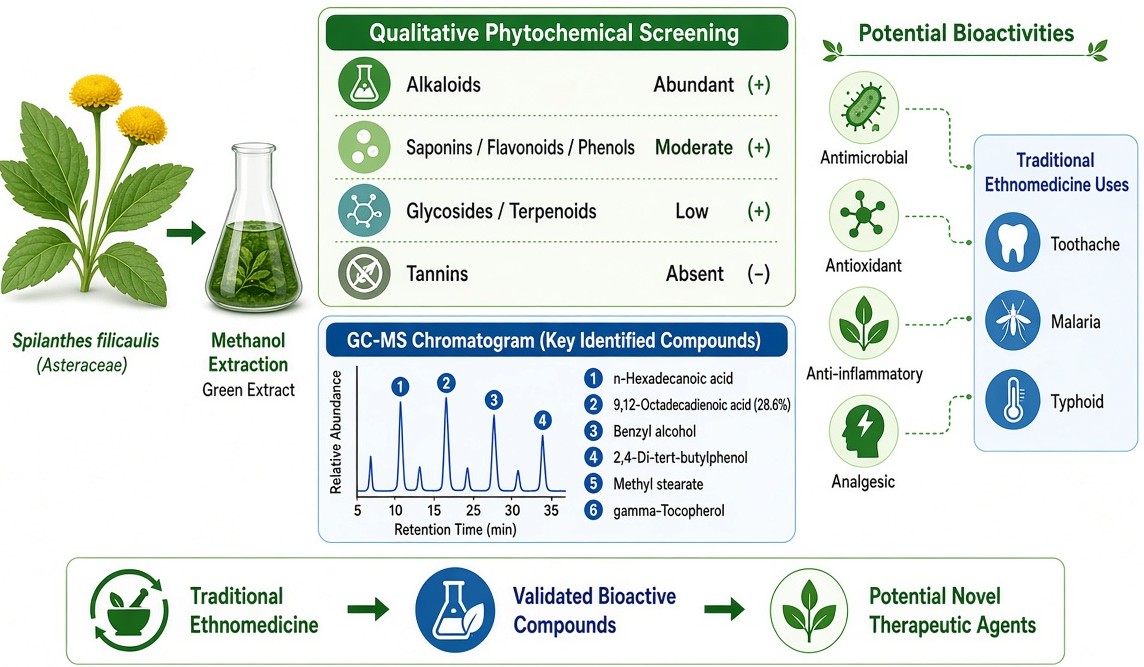
Spilanthes. filicaulis belonging the family, Asteraceae, is known for its medicinal benefits and wide applications in the traditional treatment of varieties of ailments including toothache, malaria and typhoid fever especially in Nigeria. Several species within the genus Spilanthes are tropical plants that are extensively used in traditional medicine and as flavoring agents in food preparations. Although some individuals find the spilanthol-induced tingling sensation on the tongue unpleasant, cooking reduces this effect, allowing the plant to be consumed as a green leafy vegetable. Secondary metabolites are a valuable source of potential therapeutic agents. The plant is widely used in ethnomedicine, remains poorly validated scientifically. The current study investigated the phytochemical composition of S. filicaulis methanol extract. Qualitative phytochemical analysis was carried out using various chemical tests. The analysis revealed abundant alkaloids, moderate amount of saponins, flavonoids, and phenols, with minute quantity of glycosides, cardiac glycosides, and terpenoids, while tannins were absent. Gas Chromatography–Mass Spectrometry, a combination technique for separating and identifying compounds was carried out to check for the presence of specific compounds. Gas Chromatography-Mass Spectrometry (GC-MS) analysis further identified several compounds including benzyl alcohol, palmitoleic acid, dibutyl phthalate, n-hexadecanoic acid, and methyl stearate. The study shows that S. filicaulis contains bioactive compounds with perhaps promising pharmacological potential that may give credence to its traditional use in treating the aforementioned human health conditions. In addition, these findings suggest a lead to further exploration of the plant leaf as a potential source of novel therapeutic agents.
Article Details

This work is licensed under a Creative Commons Attribution-NonCommercial 4.0 International License.
References
1. Gonçalves LA, Silva TR, Almeida RP. Phytochemical constituents and pharmacological properties of Spilanthes species: A review. J. Herb. Med. Res. 2021; 12(3): 158-173.
2. Dosumu OO, Oluwniyi AG, Oyedeji O. Nutritional composition and antimicrobial properties of three Nigerian condiments. Niger. Food J. 2012; 30(1): 43-52.
3. Schafhauser T, Kulik A. Isolation and purification of natural products from microbial cultures, Methods Mol. Biol. 2023; 2601: 75-96. https://doi.org/ 10.1007/978-1-0716-2855-3-5.
4. Gaudencio S, Bayram S, Luki´c E, Bilela E, Cueto M, Diaz-Marrero A, Haznedaroglu B. Advanced methods for natural products discovery: bioactivity screening, dereplication, metabolomics profiling, genomic sequencing, databases and informatic tools, and structure elucidation, Mar. Drugs. 2023; 21: 308. https://doi.org/10.3390/md21050308.
5. Alemu ME, Lulekal Z, Asfaw B, Warkineh A, Debella A, Abebe. Antibacterial activity and phytochemical screening of traditional medicinal plants most preferred for treating infectious diseases in Habru District, North Wollo Zone, Amhara Region, Ethiopia, Plos One. 2024; 19. e0300060, https://doi.org/10.1371/ journalpone.0300060.
6. Ralte L, Sailo H, Singh YT. Ethnobotanical study of medicinal plants used by the indigenous community of the western region of Mizoram, India, J. Ethnobiol. Ethnomed. 2024; 20: 1-24. https://doi.org/10.1186/s13002-023-00642-z.
7. Muhakr MAYM, Ahmed LM, El hassan GOM, Yagi S. Ethnobotanical study on medicinal plants in Melit area (North Darfur), Western Sudan, J. Ethnobiol. Ethnomed. 2024; 20: 1-18. https://doi.org/10.1186/s13002-023-00646-9.
8. Ojo O, Kamdem MHK, Mmutlane EM, Ndinteh DT. Cytotoxicity and antimycobacterial activity of fractions and chemical constituents of Lecaniodiscus cupanioides Planch. Ex Benth, J. Herbmed. Pharmacol. 2024; 13: 399-406. https:// doi.org/10.34172/jhp.2024.44959.
9. Fik-Jasko´łka M, Mittova V, Motsonelidze C, Vakhania M, Vicidomini C, Roviello GN. Antimicrobial metabolites of Caucasian medicinal plants as alternatives to antibiotics, J. Antibiot. 2024; 13: 487. https://doi.org/10.3390/ antibiotics13060487.
10. Wirtu SF, Ramaswamy K, Maitra R, Chopra S, Mishra AK, Jule LT. Isolation, characterization and antimicrobial activity study of Thymus vulgaris, Sci. Rep. 2024; 14: 21573. https://doi.org/10.1038/s41598-024-71012-2.
11. Angelini P. Plant-derived antimicrobials and their crucial role in combating antimicrobial resistance. J. Antibiot. 2024; 13: 746. https://doi.org/10.3390/ antibiotics13080746.
12. Ojo O, Olusola RE, Ojo OO. Spilanthes filicaulis (Schumach & Thonn.) C. D. Adams: An insight into ethnopharmacologically important but scientifically understudied species, Ann. Pharm. Françaises 2024; 82: 980-993. https://doi.org/ 10.1016/j.pharma.2024.05.010.
13. Wekesa D, Mambo F, Barasa E, Soita E, Gosar AA, Kitungulu N. Antiplasmodial and cytotoxic activities of selected medicinal plants in Western Kenya, J. Phytopharm. 2023; 12: 218-229.
14. Ojo OA, Ogunlakin AD, Akintayo CO, Olukiran OS, Adetunji JB, Ajayi OOA. Spilanthes filicaulis (Schumach. & Thonn.) C.D. Adams leaves protect against streptozotocin-induced diabetic nephropathy, Plos One. 2024; 19. e0301992. https://doi.org/10.1371/journal.pone.0301992
.
15. Ofeniforo BE, Nwikwe DC, Agada SE, Balogun EA. Assessing the oxidative stress reducing potential of Spilanthes filicaulis (Schumach & Thonn) ethyl-acetate sub-fractions on Plasmodium berghei infected female mice, Acta. Parasit. 2024; 69: 1990-1997. https://doi.org/10.1007/s11686-024-00925-9.
16. Ofeniforo BE, Ogunro OB, Agada SE, Adam AA, Ajayi MG, Balogun EA. Evaluation of serum and tissue biochemical assays of Rattus norvegicus after subacute oral administration of ethyl acetate sub-fraction of Spilanthes filicaulis, Futur J. Pharm. Sci. 2025; 11: 65. https://doi.org/10.1186/s43094-025-00812-8.
17. Da Silva, FFM, Doughari JH, Chanji FJ. In-vitro antibacterial activities of extracts of Nauclea latifolia and Daniella oliveri. Sci. Res. Essays. 2023; 3: 102-105.
18. Castellani, MP, Gozalbo D, Rico H. Coliform bacteria in fresh vegetables from cultivated lands to consumers. In Current research, technology and education in tropics in Appl. Microbiol. and Biotechnol. 2020; 10(2): 67-90.
19. Ibekwe VO, Ezeji EB. Comparative antibacterial effects of methanol and aqueous extracts of Spilanthes filicaulis root and leaf. Int. J. Pharmacogn. Phytochem. Res. 2011; 3(6): 45-49.
20. Ajaiyeoba E. Antimicrobial potentials of plant extracts in combating microbial resistance: A review. J. Ethnopharmacol. 2018; 15(7): 134-144.
21. Lawal AM, Lawan MM, Apampa SA. Phytochemical analysis and thin layer chromatography profiling of crude extracts from Guiera senegalensis (Leaves). J. Biotechnol. Biomed. Sci. 2019; 3(3): 7-12.
22. Solanki SL, Modi CM, Patel HB, Patel UD. Phytochemical screening and thin-layer chromatography of six medicinal plants from the surroundings of Junagadh, Gujarat, India. J Pharmacogn Phytochem. 2019; 8(4): 3122-3126.
23. Wilde TJJD, Ben IO, Woode E, Abotsi WKM. Preliminary phytochemical screening and in-vitro antioxidant properties of Trichilia monadelpha (Thonn.) JJ De Wilde (Meliaceae). J. Med. Biomed. Sci. 2013; 2: 6-15.
24. Harborne JB. Phytochemical methods - A guide to modern techniques of plant analysis. New Delhi: Springer Pvt. Ltd; c2005. 8.
25. Pettersen EF, Goddard TD, Huang CC, Couch GS, Greenblatt DM, Meng EC. UCSF Chimera—A visualization system for exploratory research and analysis, J. Comp. Chem. 2004; 25: 1605-1612. https://doi.org/10.1002/ jcc.20084.
26. Isah AO, MacDonald I, Muhammed HM. DNA antinicking and phytochemical properties of methanol extract of Crossopteryx febrifuga (Afzel. ex G. Don) Benth. LAJANS. 2025; 10(1): 105-112.
27. Alqahtani FY, Aleanizy FS, Mahmoud AZ, Farshori NN, Alfaraj R, Alsheddi ES. Chemical composition and antimicrobial, antioxidant, and anti-inflammatory activities of Lepidium sativum seed oil, Saudi J. Biol. Sci. 2019; 26: 1089-1092. https://doi.org/10.1016/j.sjbs.2018.05.007.
28. Ganesan T, Subban M, Christopher Leslee DB, Kuppannan SB, Seedevi P. Structural characterization of n-hexadecanoic acid from the leaves of Ipomoea eriocarpa and its antioxidant and antibacterial activities, Biomass. Conv. Bioref. 2024; 14: 14547-14558. https://doi.org/10.1007/s13399-022-03576-w.
29. Syed RU, Moni SS, Alfaisal RH, Alrashidi RH, Alrashidi NF, Wadeed KM. Spectral characterization of the bioactive principles and antibacterial properties of cold methanolic extract of Olea europaea from the Hail region of Saudi Arabia, Arab. J. Chem. 2022; 15: 104006. https://doi.org/10.1016/j. arabjc.2022.104006.
30. Alawode TT, Lajide L, Olaleye M, Owolabi B, Stigmasterol and β-sitosterol: Antimicrobial compounds in the leaves of Icacina trichantha identified by GC–MS, Beni Suef Univ. J. Basic Appl. Sci. 2021; 10: 1-8. https://doi.org/10.1186/s43088- 021-00170-3.
31. Akoachere JF, Suylika Y, Ajeck MJ, Ayimele G, Assob J, Pierre FC. In vitro antimicrobial activity of agents from Spilanthes filicaulis and Laportea ovalifolia against some drug-resistant bacteria, Br. J. Pharm. Res. 2015; 6: 76-87. https://doi.org/10.9734/BJPR/201.
32. Ruth EO, Inemesit AU, Johnson OM, Taiwo TO, Olusesan O. Antimicrobial effects, phytochemical profiling and In silico analysis of compounds from Spilanthes filicaulis (Schumach. &Thonn.) C. D. Adams grown in Southern Nigeria. Pharmacological Research-Natural products. 2026; 10(2026): 100585.