

In silico evaluation of antidiabetic potential of selected Uvaria chamae phytochemicals as adenosine monophosphate (AMP)-activated protein kinase modulators
Article Sidebar
Main Article Content
Abstract
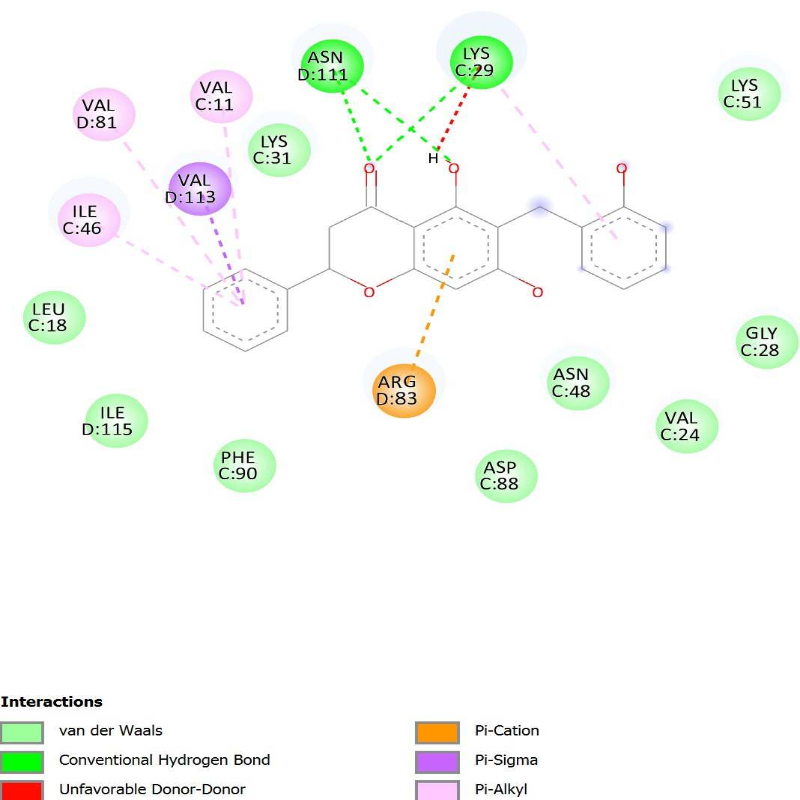
Type 2 diabetes mellitus (T2DM) remains a major global health challenge characterised by impaired glucose and lipid metabolism. Activation of AMP-activated protein kinase (AMPK), a central regulator of cellular energy homeostasis, offers a promising therapeutic strategy for improving insulin sensitivity and metabolic balance. This study employed an in silico approach to evaluate selected phytochemicals from Uvaria chamae, including chamanetin, dichamanetin, uvaretin, isouvaretin, isochamanetin, pinocembrin, and linalool, for their potential as AMPK modulators. The compounds were assessed for physicochemical properties, drug-likeness, pharmacokinetics, and toxicity using SwissADME and ProTox-II, while molecular docking against the AMPK catalytic domain (PDB ID: 4CFF) was done using AutoDock Vina. All phytochemicals adhered to drug-likeness criteria and exhibited good oral bioavailability, with no structural alerts. Docking results revealed strong predicted binding affinities, ranging from -5.2 to -9.5 kcal/mol, compared with metformin (-4.5 kcal/mol). Chamanetin and dichamanetin showed the most favourable interactions with key residues within the AMPK ATP-binding pocket, suggesting potential as lead scaffolds for direct AMPK modulation. These findings provide molecular insight supporting the traditional use of Uvaria chamae in diabetes management and justify further biochemical and pharmacological validation of its active constituents.
Article Details

This work is licensed under a Creative Commons Attribution-NonCommercial 4.0 International License.
References
Hossain MJ, Al-Mamun M, Islam MR. Diabetes mellitus, the fastest growing global public health concern: Early detection should be focused. Health Sci Rep. 2024;7:1–5.
Antar SA, Ashour NA, Sharaky M, Khattab M, Ashour NA, Zaid RT, Roh EJ, Elkamhawy A, Al-Karmalawy AA. Diabetes mellitus: Classification, mediators, and complications; A gate to identify potential targets for the development of new effective treatments. Biomed and Pharmacother. 2023;168:1–25.
Abu OD, Umar A-B, Ekperusi SE, Ohikhuare F. Assessment of cardiac oxidative status of diabetic Wistar rats exposed to methanol fraction of ethanol extract of Dialium guineense stem bark. Biomed J Sci Tech Res. 2024;57: 49002–49009.
Lamoia, TE, Shulman GI. Cellular and molecular mechanisms of metformin action. Endocr Rev. 2021;42:77–96
Ibrahim SO, Lukman HY, Ebhohimen IE, Babamale HF, Abdulkadir FR, Zubair MF, Atolani O. Chemoinformatic-aided antidiabetic analysis of the therapeutic potential of phytoconstituents in Eremomastax speciosa extracts. Borneo J Pharm. 2024;7:172–186
Grant PJ, Cosentino F. The 2019 ESC Guidelines on diabetes, pre-diabetes, and cardiovascular diseases developed in collaboration with the EASD. Eur Heart J. 2019;40:3215–3217.
Goel S, Singh R, Singh V, Singh H, Kumari P, Chopra H, Sharma R, Nepovimova E, Valis M, Kuca K, Emran TB. Metformin: Activation of 5′ AMP-activated protein kinase and its emerging potential beyond anti-hyperglycemic action. Front Genet. 2022;13:1-15. https://doi.org/10.3389/fgene.2022.1022739
González-Casanova JE, Navarro-Marquez M, Saez-Tamayo T, Angarita L, Durán-Agüero S, Fuentes-Barría H, Bermúdez V, Rojas-Gómez DM. New Perspectives on the Molecular Action of Metformin in the Context of Cellular Transduction and Adipogenesis. Int J Mol Sci. 2025;26:3690. https://doi.org/10.3390/ijms26083690
Entezari M, Hashemi D, Taheriazam A, Zabolian A, Mohammadi S, Fakhri F, Hashemi M, Hushmandi K, Ashrafizadeh M, Zarrabi A, Ertas YN, Mirzaei S, Samarghandian S. AMPK signaling in diabetes mellitus, insulin resistance and diabetic complications: A pre-clinical and clinical investigation. Biomed & Pharmacother. 2022;146:1–17.
Ebhohimen IE, Izevbigie ON. Nephroprotective Activities of Medicinal Plants and Natural Drugs. in Biopharmacological Activities of Medicinal Plants and Bioactive Compounds. Eds. Singh, A. & Bithel, N. Nova Science Publishers, New York, 2021;231–244.
Ebhohimen IE, Idiakheua OD, Itamah RO, Orowo EO. Antioxidant capacity of Azadirachta indica, Persea americana, and Mangifera indica leaves polyherbal extract. Trop J Nat Prod Res. 2025;9:896–902.
Daï EH, Hermann HJS, Idohou R, Ouédraogo A, Kakaï RG, Hotes S, Assogbadjo AE. Modeling current and future distribution patterns of Uvaria chamae in Benin (West Africa): Challenges and opportunities for its sustainable management. Heliyon 2023;9:1–11.
Mutiu AA, Miracle MA, Nabilat TY, Emmanuel OA. In vitro anti-inflammatory and anti-ulcerogenic potential of ethanol extract of Carica papaya leaves: Phytochemical and molecular docking studies. TJPPS. 2025;4:341–354.
Tupas GD, Otero MCB, Ebhohimen EI, Egbuna C, Aslam M. Anti-diabetic lead compounds and targets for drug development. in Phytochemistry: An in-silico and in-vitro Update. Eds. Kumar, S. & Egbuna, C. Springer Nature, 2019;1–23.
Agbebi EA, Omotuyi OI, Oyinloye BE, Okeke UB, Apanisile IO, Okor B, Adefabijo D. Ethnomedicine, phytochemistry, and pharmacological activities of Uvaria chamae P. Beauv.: A comprehensive review. Naunyn Schmiedebergs Arch Pharmacol. 2024;397:5421–5436.
Emordi JE, Agbaje EO, Oreagba IA, Iribhogbe OI. Antidiabetic effects of the ethanolic root extract of Uvaria chamae P. Beauv (Annonaceae) in alloxan-induced diabetic rats: A potential alternative treatment for diabetes mellitus. Adv Pharmacol Sci. 2018;2018:1314941
Sinha R, Kumar P, Sikdar A. A comprehensive review on chalcone analogues-versatile scaffold with medicinal and biological potential. J Appl Pharm Sci Res. 2023;6:10–15.
Salehi B, Quispe C, Chamkhi I, El Omari N, Balahbib A, Sharifi-Rad J, Bouyahya A, Akram M, Iqbal M, Docea AO, Caruntu C, Leyva-Gómez G, Dey A, Martorell M, Calina D, López V, Les F. Pharmacological properties of chalcones: A review of preclinical including molecular mechanisms and clinical evidence. Front Pharmacol. 2021;11:1-21. https://doi.org/10.3389/fphar.2020.592654
Popoola TD, Guetchueng ST, Ritchie KJ, Awodele O, Dempster NM, Akinloye O, Sarker SD, Fatokun AA. Potent Nrf2-inducing, antioxidant, and anti-inflammatory effects and identification of constituents validate the anti-cancer use of Uvaria chamae and Olax subscorpioidea. BMC Complement Med Ther. 2021;21:234.
Adewusi JA, Adams AA, Ibidotun TO, Ezekiel TA. Phytochemical profiling, antioxidant, and antidiabetic activities of defatted ethanol aerial extract of Heliotropium indicum: Insights from GC-MS and in vitro studies. TJPPS. 2025;4:320–328
Fall D, Duval RA, Gleye C, Laurens A, Hocquemiller R. Chamuvarinin, an acetogenin bearing a tetrahydropyran ring from the roots of Uvaria chamae. J Nat Prod. 2004;67:1041–1043.
Mariita RM, Ogol CKPO, Oguge NO, Okemo PO. Methanol extract of three medicinal plants from Samburu in Northern Kenya show significant antimycobacterial, antibacterial and antifungal properties. RJMP. 2011;5:54–64.
Huang T, Sun J, Zhou S, Gao J, Liu Y. Identification of direct activator of adenosine monophosphate-activated protein kinase (AMPK) by structure-based virtual screening and molecular docking approach. Int J Mol Sci. 2017;18: 1408.
Daina A, Michielin O, Zoete V. SwissADME: A free web tool to evaluate pharmacokinetics, drug-likeness and medicinal chemistry friendliness of small molecules. Sci Rep. 2017;7:42717.
Lipinski CA, Lombardo F, Dominy BW, Feeney PJ. Experimental and computational approaches to estimate solubility and permeability in drug discovery and development settings. Adv Drug Deliv Rev. 2001;46:3–26.
Veber DF, Johnson SR, Cheng HY, Smith BR, Ward KW, Kopple KD. Molecular properties that influence the oral bioavailability of drug candidates. J Med Chem. 2022;45:2615–2623.
Banerjee P, Kemmler E, Dunkel M, Preissner R. ProTox 3.0: A webserver for the prediction of toxicity of chemicals. Nucleic Acids Res. 2024;52:W513–W520.
Al-Nema M, Gaurav A, Lee VS. Docking based screening and molecular dynamics simulations to identify potential selective PDE4B inhibitor. Heliyon 2020; 6:1-12.
Morris GM, Huey R, Lindstrom W, Sanner MF, Belew RK, Goodsell DS, Olso AJ. Software news and updates AutoDock4 and AutoDockTools4: Automated docking with selective receptor flexibility. J Comput Chem. 2009;30:2785–2791.
Ebhohimen IE, Onyijen OH, Arora V, Arora V, Adeleke VT, Okpeku M. Mutation Pattern in the Receptor Binding Motif of SARS-CoV-2 Variants and the Effect on Molecular Interactions in Docked Ligand Complexes. Trop J Nat Prod Res. 2022;6:1262–1267.
Terefe EM, Ghosh A. Molecular docking, validation, dynamics simulations, and pharmacokinetic prediction of phytochemicals isolated from Croton dichogamus against the HIV-1 reverse transcriptase. Bioinform Biol Insights. 2022;16: 1-20.
Wong F, Krishnan A, Zheng EJ, Stärk H, Manson AL, Earl AM, Jaakkola T, Collins JJ. Benchmarking AlphaFold ‐enabled molecular docking predictions for antibiotic discovery. Mol Syst Biol. 2022;18:1-20.
Ebhohimen IE, Okolie NP, Okpeku M, Unweator M, Adeleke VT, Edemhanria L. Evaluation of the antioxidant properties of carvacrol as a prospective replacement for crude essential oils and synthetic antioxidants in food storage. Mol. 2023;28:1315.
Jîtcă G. The role of AMPK activation in metabolic regulation, energy homeostasis and aging: A comprehensive overview. ITPS. 8, 1–15 (2024).
Steinberg GR, Hardie DG. New insights into activation and function of the AMPK. Nat Rev Mol Cell Biol 2023;24:1–18.
Sugawara K, Ogawa W. New mechanism of metformin action mediated by lysosomal presenilin enhancer 2. J Diabetes Investig. 2023;14:12–14 https://doi.org/10.1111/jdi.13925.
Clemente-Suárez VJ, Martín-Rodríguez A, Beltrán-Velasco AI, Rubio-Zarapuz A, Martínez-Guardado I, Valcárcel-Martín R, Tornero-Aguilera JF. Functional and therapeutic roles of plant-derived antioxidants in Type 2 Diabetes Mellitus: Mechanisms, challenges, and considerations for special populations. Antioxidants. 2025;14:725. https://doi.org/10.3390/antiox14060725
Sanvee SCJ, Kombate B, Kantati YT, Kpoyizoun PK, Badjabaissi E, Assih M, Diallo A, Bakoma B. Phytochemistry, antihyperglycemic, antioxidant and anti-inflammatory Properties of Uvaria Chamae and Sida linifolia extracts: Potential implication in diabetic disease. Phcog J. 2024;16:582–590.